Tuesday, January 31, 2023

Measuring Work


An interesting article, however it would have more value if it used a more relevant measure of work effort than counting footsteps. A count of 12,000 steps versus 9,000 steps is not an indicator of more work (1.33 times), nor harder work. As with time measurement foot step counting is a poor indicator of work effort.

Also electronic foot step counters do not actually count foot steps, they have sensors which sense vibration, acceleration and movement, which is equated to a foot step. It is possible to be sat down but not still, and achieve a foot step count, it is also possible to be walking and get zero foot steps, they maybe fun but they are not reliable.

Similarly fitness trackers estimates of heart rate and calories burned are based on lots of statistical wrangling and assumptions, two different brands of trackers are likely to give different results. The point of counting steps is to estimate distance based on averaged length of stride, even though the tracker is calibrated to the individuals stride, a persons stride is not constant and is likely to vary during a trip. A measuring wheel will provide a better measure of distance, or a map will provide a reasonable estimate. Basically a fitness tracker is just a  wrist watch, measuring chunks of time and making assumptions about that time and calculating various things on the basis of assumptions about feedback from various sensors. Probably do as well with an ordinary wrist watch and do own calculations: point of tracker is it saves some effort and provides a more instantaneous result rather than at some time afterwards. It thus provides feedback allowing adjustment of behavior.

Also a few months back I read an article by an health and fitness writer, she was discussing the issues of couples exercising together and the 10,000 step recommendation. Basically if they go for a walk together, and they have different strides, then if one achieves the 10,000 steps the other will either be behind on their step count or in front. Assume that an average stride is less than 1m, then 10,000 steps is a distance less than 10km. Average walking speed is typically taken as 5km/h or the slightly less 80m/min, additionally typically expect to change mode of movement from walking to jogging/running at around 7km/h.

So assume a couple both complete a 5km trip in 1 hour, then on the face of it  they are both walking at 5km/h. Except their strides are not the same, so similar situation to different diameter wheels, the smaller wheel has to do more revolutions per minute than the larger wheel. Say one has a stride of 1m and the other 0.8m, a ratio of 1.25. Then one has made 5000 steps, whilst the other has made 6250 steps, or 83 steps/min compared to 104 steps/min.

So whilst completing the same external work, travelling 5km, the internal work of their bodies is different. Their elevated heart rates will be different, and the fuel each burns will be different. Do we also have a situation of one walking at 5km/h and the other running at 5km/h?

So what do we measure as work, and is it the useful external work of importance or is it the internal work of our bodies we need to measure or both?

Now in physics (mechanics), work done (energy) is the product of force(F) and distance(s)  to give (W=F.s) and is measured in Joules(Nm=J). Whilst power is work done divided by time (P=W/t=F.s/t=F.v where v=s/t) and measured in Watts (J/s=W). Also friction force is the product of the force normal to the surface and a friction coefficient (F=mu.N), the normal force is typically the weight of the object in Newtons (Weight=m.g=m 9.81). The friction coefficient is typically less than one, therefore less force is required to slide something than to lift it off the ground. Also rolling resistance is typically less than sliding resistance, so even less force is required to push/pull something on wheels.

Now the calories count on most trackers and gym equipment is an estimate of fuel used, not useful external work. The human body has an efficiency of around 25%, that is only 25% of the fuel used produces useful external work. So from the fitness tracker we can get calories, distance and time. We can estimate external work done (W) as 25% of the calories, we get velocity from distance and time, and can get an estimate of the force exerted from F=W/s, and power from P=W/t. The person with the higher force and the higher power is working harder. {NB; Working longer isn't considered working harder}

Now would expect the heavier person to exert the higher force, since distance is constant for both people, therefore expect work done W=F.s to be higher, and the time is the same for each therefore P=W/t will be higher. 

Except the person with the shorter stride is doing a lot more internal work, a lot more leg movements, possibly higher heart rate, and therefore expect to be burning more calories, but not expecting a higher force, and as over all speed is the same, not expecting higher power P=F.v.

But would expect similar power outputs only if smaller force is combined with higher speed. So would require looking at the mechanics of the activity in more detail, for example walking involves both vertical and horizontal movement, lifting an heavy body off the ground requires more force than lifting a lighter body, also sliding or rolling a heavy body requires more force than a lighter body. So who does burn the most calories for the task? Also who is operating closer to their maximum heart rate (MHR), as they would also be working their body harder.

Also need to take into consideration the environment. I recollect reading a book which indicated that traditional Canadian lumberjacks, with an axe, burned some 10,000 Calories (kcal) per day. But this isn't from the work alone, this is mostly just being in the cold. So two people operating in different environments will be burning different amounts of calories.

It is to be noted that sport, health and fitness have theories and equations to do some numbers on maximum heart rate (MHR) and calories. For example based on the various equations for MHR mine varies between 162.5 to 174.2 beats per minute. Exercise at about 90% of MHR is anaerobic metabolism, exercise is typically set around 65% to 85% of MHR. Would therefore expect work to be less than this as typically lasts for longer than exercise. MHR is dependent on age, with younger having higher MHR.

Energy needs are typically based on base metabolic rate (BMR) or resting metabolic rate (RMR), the equations for BMR are dependent on gender, weight, height and age. Total daily energy expenditure (TDEE) is then determined by using a multiplier to account for level of activity. With females typically having a lower BMR than males, so if all other parameters are equal women need less energy. Further given required energy reduces with weight and height, and women typically lighter and shorter, then even less energy required. 

This suggests that calorie counting possibly no better than step counting, as expect females to count more steps and burn less fuel for the same task compared to males. On the other hand if males are typically heavier then the force required to shift their weight is greater, so W=25%C, where C is the calorie count, may give a valid estimate of work done, and then a valid estimate of force from F=W/s. This poses a different issue: heavier people have to do more work for a given task. Therefore need to measure the task by some value which is constant, such as travelling 5km, or moving 90 L of water. Also consider weight ratio's and various other ratio's which assist in an equitable comparison.  For example an average fit person can generate about 3 Watts/kg for an hour, so the heavier they are the more power they can generate, but the more power they need to shift their weight. If weight has a negative impact on a task then the extra power may not be a benefit.

As well as calculating MHR it is also possible to estimate VO2 max, which is a measure of peak oxygen consumption during activity, oxygen being required for combustion of food/fuel. This being measured in ml/kg/min, which for a given body weight can be converted to L/min, and kcal/min and Watts, from VO2 max, exercise levels, or in our case work, can be based on oxygen uptake reserve (VO2R). If concerned with exercise type work, then there are formulae available for walking, running, cycling, arm cycling, and stepping. For other activities can use metabolic equivalents MET's from the compendium of physical activity. Ironing clothes for example is 1.8 MET's, cooking and food preparation is 2 MET's. carpentry general workshop work is 3 MET's, walking at 3 mph (4.8km/h) with light load 4.5 MET's. 

So from activity sampling, and time measurement can get an assessment of daily energy requirements from calculated MET's. Again this is based on fuel, not useful external work, again can estimate useful work at 25%. Note that in calculating energy in kcal or kJ from MET's that an allowance is made for weight. So the heavier person is using more fuel.

The sociologists work was with cultures in Asia, and one noticeable trait is that the males and females are typically not significantly different in height, breadth and weight: that is their basic skeletal frames are similar proportions. Any difference likely due to bone density and muscle mass, that is the males likely slightly heavier due to more muscle mass with stronger muscles wrapped around thicker heaver bones. So are the equations for BMR which vary by gender, valid for such culture? Males and females do have different body chemistry, but is it significant enough to alter BMR?

It does appear that there is no simple single measure of work. Work needs to be defined by multiple characteristics, such as distance, time, weight, energy and power. Also need to reference external work, and the internal work of the human body. If internal work being considered, then MHR and VO2 max, and fuel energy used are also useful measures.

However, hard work should be considered high force or high power, with duration also considered with respect to fatigue from work. Also working at a high percentage of MHR for longer durations may also be considered hard work.

However, time alone does not equate to hard work, 20 hours work versus 8 hours does not make the longer duration hard work. Similarly more foot steps per day does not equate to more work or hard work.

It does however seem that industrial engineering could benefit from the work of sports and fitness medicine, as can the design of human powered machines.


Related Posts

Revisions:
[31/01/2023: 15:55] : Original

Wednesday, March 23, 2022

Vote For Democracy Not Short Term Dictatorship

So South Australia just had a state election: Saturday 19 March 2022.

The state government comprises of members of two houses, the house of assembly, and the legislative council, It does not comprise of half the members of one house. I contend that it is incorrect to refer to the dominant political party as the government.

We have elected representatives of the people, distributed between a lower and upper house. from these representatives an executive council is selected to advise on the will of the government and execute the will of the government. The representatives are meant to determine the needs of the people. consider the constraints, reconcile conflicting requirements and debate the suitability of alternative solutions, so as to determine the will of the people. But this doesn't happen.

Liberal has lost and Labor has won. How can that be? Before the current election the house of assembly comprised of members of the Liberal party and the Labor party. The house of assembly still comprises of members of the Liberal and Labour parties: so no real change to the government.

Labor will blame Liberal for the current purported mess. They will proceed to dismantle systems implemented by the Liberals, and then proceed to implement their own systems. In a few years the population will get disenchanted and supposedly throw Labor out and put the Liberals back. The process of dismantling and implementing will start again. It is all extremely wasteful.

Labour occupied the house of assembly at the same time as the Liberals, if the systems the Liberals wanted to implement were not in the best interests of the people then why didn't Labor stop them, right there and then? If they claim because they couldn't, then why not? If Liberals just out vote them and push policy through, then the Labor MP's were a waste of space, not required, just send them home, and don't pay them, Similarly the Liberal MP's are now a waste of space, so likewise send them home and don't pay them. 

That however is not how the system is meant to work. There is supposed to be real debate, we are not supposed to have a short term dictatorship. Such hijacking of the government, and dictatorship is a function of the political parties it is not part of the constitution, and I contend it is not an acceptable operation of our government. The journalists talk about the two party preferred. How can we have two party preferred? We clearly vote for multiple parties not just two. The problem we have is the two parties and a lack of diversity in the government and consequently lack of due and proper representation of the people. An election which merely changes which side of the floor, Labor and the Liberals, sit is a joke. These two political parties need kicking out off both houses of the government.

The problem is the other political parties are generally not taken seriously as they only have a single idea, radical philosophies, stupid names or no policies. There is also a misconception that a party needs to have policies. We do not really need a government: we just need to approve transfer of funds from the treasury to the government departments and continue service as usual. The peoples representatives only need to be called upon to deal with exceptions, constraints, shortages, and emergencies. That is the government needs to be dynamically adaptive and respond to change. Therefore not interested in the policies, political parties have before an election, only interested in how they will respond to the circumstances they encounter.

I suggest no political party should have more than 20% of the seats, so that we require at least 5 political parties to be voted into the government. The members of the executive council can be selected from the lower and upper houses and across all political parties: because they all constitute the government and the executive councils task is merely to advise on the will of the government, and execute the will of the government. It is not the task of the executive council to impose its will on the government.

But since we don't have a rule, just have to play the game. So can create 5 neutral political parties, say peoples representatives team 1 to 5, abbreviated to PR-T1 to PR-T5. The only policies these parties have is to maintain the status quo and implement change only if it is necessary and justified. The change being determined on an as needs basis. If all 5 parties get elected then funds are merely approved for transfer from the treasury to the government departments and operations continue as usual. They then get on with dealing with the exceptions.

In the first instance the traditionalists will continue to vote for the party their ancestors voted for, and they will mostly do so with out thought, unlike their ancestors who choose sensibly. Those who swing between Labor and the Liberals shouldn't, this is what causes the inefficiency. It is better to pick a third party, if no suitable party then pick one of the neutral parties.

When the Australian Democrats were around, their presence in the upper house, meant that neither of the two major parties dominated the upper house, and therefore a bill could not be passed unless the democrats were on side. The displacement of the democrats by the Greens, has changed things. The Greens have relatively radical uncompromising viewpoints with respect to the environment, they do not act as moderator.

The purpose of the upper house is to interrogate a bill and determine if it truly is in the best interests of the people, that passing the bill into legislation truly reflects the will of the people. Or conclude that they are incapable of assessing the will of the people and that maybe a referendum needs to be held. If a referendum is required then we can conclude that the members of the houses are not true representatives of the people, and need to be replaced. At the same time it is also necessary to safeguard against the tyranny of the majority. If there is proper debate in the two houses, and actually operating with intent to determine the needs of the people and solve problems, then the potential for tyranny should be low.

We don't get proper debate, instead we get two bickering sides. Neither side is competent at debate, or speech. To start with they don't write their own public speeches: marketing and public relations specialists write the speeches, so how can we expect them to contribute in any meaningful way to a debate. The two houses are the battlefield and the weapons of war are words. If there are 3 or more parties in each of the houses, then have many divergent viewpoints, but may avoid a bipolar split. With 5 parties in the house, then 3 parties are required to cooperate to achieve a majority vote. Thus either the 3 neutral parties, or 2 neutral parties and one major party cooperate to a achieve passing of a bill.

It is to be noted that the members of the neutral parties should be specifically educated and trained to question and interrogate proposals put before them, and identify the flaws in the proposals. They are diplomats and excel at diplomacy. They are the monarchs of philosophy (philosopher kings). They seek to solve problems not adopt ideology. It is thus possible for 5 or more such parties to be formed and to prove themselves before an election.

We have open government, debates can be observed and they are recorded and reported. New political parties, non-government organisations (NGO) and lobby groups can be created, and they can publicly question and interrogate the decisions of the government. They can educate the population on the operation of our government and the flaws in its operation. The government can be held to account, the political parties can be held to account, and the peoples representatives can be held to account. The newly formed neutral political parties (NPP) can act as political commentators, and question the competence of the members of the two houses to provide due and proper representation of the people.

Whilst it is good that anyone can be representative of the people, it doesn't mean that they have the capability to effectively represent the people. Such people maybe better off, finding appropriate skilled people and putting such people forward, whilst they themselves take a back seat.

Point is political parties, cabinets and shadow cabinets do not have anything to do with the legal definition of our government. The political parties are simply sustained by their presence and the flawed reporting of journalists. I say flawed reporting because Labor may have won the election, but they are not the government, and Liberal was not the government before them. We should hold the government accountable and that means all political parties with members in the two houses.

References:


Related Posts

Revisions:
[23/02/2022] : Original

Saturday, November 20, 2021

Ambiguous Mathematical Expressions Due to Deficiencies and Consequential Inconsistencies of Infix Notation

Introduction

Recently I was searching for information on MS Access SQL to demonstrate that do not need MS Access to create and use MS Access databases, and in particular import text data. In the process of doing so I encountered various youtube videos which were on the wrong track, but finally found the information I was looking for here: Reading Text files into Access with ASP.NET. This being part of a larger exercise in which I will explain why Python/Jupyter is no substitute for Excel/VBA, but is otherwise a useful additional tool.

Any case whilst skimming the youtube videos I bumped into this nonsense:


It is relative clear by clicking "SHOW MORE" that the article is not about mathematics but about marketing and sales of the merchandise listed. The author purports that the correct answer is 24, and presents expression trees to prove his answer. He does not parse the expression given according to the rules of BODMAS or PEMDAS, as these rules are irrelevant to expanding the ambiguous compressed expression into a properly formed mathematical expression.

How a calculator parses such expression is entirely dependent on how the makers of the calculator interpret such expression and write their expression parser. The two calculators the author illustrates are google search and an android calculator, both of which are likely to use an expression parser written by google: therefore not two independent sources and thus bad science.

The correct answer is that the expression is a poorly formed mathematical expression and has no single answer as a consequence. Depending on where you live, the work you do, and your past education, you may consider one answer is more desirable than another: but it does not make it correct. If I have to give a numerical answer to such defective expression then my preference is that the answer is 6 not 24.

More generally we could write the expression has: A÷B(C-D). However since all the programming languages and computing environments I use do not accept the obelus '÷' , and only accept '/', it is also cumbersome using '÷', I will modify the expression to A/B(C-D), where it is assumed that '÷' and '/' have equivalent meaning. That is everything after '/' is not assumed to become a denominator. Also '*' is used for multiplication rather than 'x', though in some environments it is represented by a vertically centred dot '∙' however for simplicity of typing I will use '.'.

Merely Insert a Missing Operator

If you believe the expression is simply compressed by deleting an operator and all that is required is to insert such operator. Then would translate A÷B(C-D) into A÷B*(C-D) , then applying your preferred acronym, this further transforms into (A÷B)*(C-D) , and so get (60/5)*(7-5)=(12)*(2)=24.

This would appear to come from the believe that () means multiply. I would contend that such believe is flawed.

Rules of Compression

However if you have more involved rules of compression then such answer is not acceptable. Now the rules of compression (laziness) I learned, not (BODMAS or PEMDAS), inform me I can express  B*(C-D) as B(C-D). In compressing the expression in such manner the prefixed operand is bound to the contents of the brackets to create an immutable compound expression block, and it is this binding which implies multiplication between the prefix operand and the contents of the brackets. Where ever the brackets go, the prefix follows, that is B() cannot be broken apart: if the prefix operand is separated from the (), then the implied multiplication does not exist. This expression can be further reduced by setting E=(C-D), to give BE, and a step further by setting F=BE, because the block is immutable. Thus the expression collapses to A÷F or A/F. Thus F=5*(7-5) = 10, and A/F=60/10=6. This is otherwise equivalent to: A / (B*(C-D)), that is B() to retain the expression block becomes (B*()).

Now if 24 is the desired answer, then the rules of compression I learned would require the expression be presented as (A÷B)(C-D) in the first place, and it was not. Note the operator which has been eliminated would lie between the two sets of brackets: ()*() compressed to ()(). Therefore the answer 24 is incompatible with the system of rules I learned, as it is not correctly compressed.

It should be noted these rules do not have anything to do with BODMAS or PEMDAS, nor with commutation, association or distribution. The rules are simply a means of compressing formal expressions into a more compact form by eliminating operators, and defining expression blocks. This compression has to be removed before the acronym rules can be applied.

I believe this concept of the expression blocks partially assists with the issues and conventions described in the following paper: Discussions: Relating to the Order of Operations in Algebra on JSTOR. Today it maybe addressed by adding the concept of juxtaposition, and revising the acronym to PEJMDAS, however I don't believe this fully addresses the issues of compressed expressions and other shortcuts in notation. For example () do not mean multiply, only the binding of the prefixed operand implies multiplication: and the binding occurs by removing the operator.

On Notation

I don't recollect being taught anything about juxtaposition, and BODMAS was little needed after moved beyond basic arithmetic. For that matter I forgot what the 'O' stood for and typically considered it was 'of' and didn't know why it was there other than it possibly did connect brackets and multiplication and division. Given it apparently refers to 'orders', then its a very long time ago I ever referred to exponents as orders: as in by grade 12 it was history. Point is generally don't need the silly acronyms, as fundamental requirement is to clearly communicate intent.

None of my text books used inline expressions using '/', so didn't have the problem of a/bc meaning a/(bc). With the increased use of computers, and calculators which accept algebraic expressions, there has apparently been an increase in the use of '/' in textbooks and a decrease in typeset expressions using horizontal lines to separate numerator from denominator.  I generally expect reference books to present expressions in the following manner:


However, I do not expect to write expressions like that myself, as my task is to evaluate the results and make decisions. It is not my task to communicate in detail how I go about reaching decisions, rather it is my task to outline the decision process and present the decision. In other words I don't have to show the expression at all. However, if I am deriving something for the first time, and need to explain my approach then I expect to present the required expressions. For routine design calculations, presenting such expressions is a waste of time and paper, as everyone involved is meant to know the requirements. Also people on the regulatory side of things are meant to be checking my conclusions not my calculations, if and only if we have a difference of opinion, does it become necessary for me to present my calculations in greater detail.

Also, my generation, we wouldn't naturally write a/bc if we meant a/(bc), as we would assume it is ambiguous to others: even though we would expect that bc is a compound or bound expression which should not be split. That is if we intended (a/b) then we would write c(a/b), not (a/b)c, this is not because I consider the latter invalid, as expect such results when manipulating expressions, it is just convention to prefix the () with a single operand, not postfix.

The other issue with a/bc is whether or not 'bc' is a single variable name or two variables multiplied together. In mathematics and physics we tend to only use single character variable names, but in other areas, two or more characters are used for variable names {which off the top of my head I cannot remember any, but they tend to be from accounting and economics}.

So if want to clarify that bc is two variables and not a single variable name, would use dots as multipliers, so would write something like a/b.c. Now have a problem because b.c is no longer a bound expression, and would most likely translate as (a/b).c

When using programming languages, whilst most of the time we can use single character variables, it frequently becomes preferable to use multiple character names to help distinguish one variable from another. For example, σ is frequently used to represent stress and also standard deviation. So first problem is most programming languages do not support Greek characters, so would use the English name, 'sigma', now it doesn't make sense to use the name 'sigma' for everything, when we can equally well use the name 'stress' and 'stddev' to more properly distinguish the two variables.

Another point is that subtraction is the inverse of addition and division is the inverse of multiplication. That multiplication is just a shortcut notation for repeated additions, and exponents are shortcut notation for repeated multiplications. So most expressions or standard formulae are based on addition and multiplication, and we substitute negative numbers and fractional numbers into such formulae.

Expression1: A÷B(C-D) becomes A*(1/(B*(C+(-D))))

and thus we seek shortcut notations, to compress such expressions.

For those who seem to mindlessly and bombastically regurgitate the rules of PEMDAS, why for example would I need such a rule to evaluate 3+32 ? Why would I translate it into 3+3*3=(3+3)*3 ? Clearly I cannot add anything until I know the value of 32. Similarly I cannot proceed with anything until I have evaluated the contents of brackets, and I cannot add products and quotients to anything until I evaluate them. It would seem that school book exercises are silly exercises in mindless application of silly rules, to deliberately misleading expressions. The poorest of education failing to explain the complexities of the real world.

“Rules are for the obedience of fools and the guidance of wise men.”  - Douglas Bader

Other Notations

Consider this usage in construction 2/M16-8.8/s bolts, or 2/90x45 F7 studs, in both instances the '/' means multiples of that which follows, except where it is just a separator of characters. Further more 90x45 is a compound expression, defining dimensions of a rectangular section. And '-' does not mean subtract, it is simply a separator of characters.

Or another example: Buildex 12-14 x 20mm Hex Head Metal Tek Screws, in neither case are '-' and 'x' really arithmetic operators. It describes a Number 12 or #12  or No.12 screw, which is the gauge size of the screw and gives its diameter, whilst 14 concerns the thread, and gives the threads per inch and 20mm is the length. {Wouldn't want to confuse anyone with consistency now would we?}

Deficiencies of Infix Notation

Now the rules of mathematical expression we use are clearly inconsistent. We use infix notation for the arithmetic operators [*,/,+,-], but we do not use infix notation for other operations.  For example what does sin() mean? Does it mean multiply the variables 's', 'i' and ''n' by the contents of the brackets, or is it an abbreviated function name for sine? And what about sinθ, and 2sin2θ, now have missing operators and missing function parameter brackets. Then there are rules for exponents, which also do not follow infix notation. The context and intent of the author of the expression needs to be understood. But such inconsistencies are not necessary.

Calculators

When I was at school, the expectation was we would be taught how to use a slide rule, however when we arrived at that year they changed to teaching the use of calculators.

The primary calculators chosen were supposedly algebraic logic calculators (AL), though there were two variants of such. I can't remember the difference between the two, though I believe it had to do with the inconsistencies of infix notation and how the calculators accepted input for those operations which do not follow infix rules: for example exponentiation, trigonometry and logarithmic functions and the likes were handled differently. There were recommended calculators, but these were not mandatory. So not all students had calculators which used the same system.

I especially didn't as I used an HP RPN calculator. Use of this type of calculator was not being taught, but I was allowed to use, and I was responsible for learning so. It was common for students to argue about who had the better calculator on the basis of the number of levels of parentheses it allowed, the more the better. My calculator had zero parentheses. Besides this causing problems for people borrowing my calculator, there was also no equals sign, they would go away and come back a few minutes later asking where the '=' was. I would explain there wasn't any, and that would cause confusion

It is also interesting to note that HP handbooks explained the use of the 4 register stack (XYZT) which it used, whilst handbooks for other calculators did not explain the operation of their 2 register stack (XY) which they used. It is the operation of the stack which removes the need for parentheses and '='. 

Calculators which allowed algebraic expressions were not available, so all calculations required transforming expressions prior to input to the calculator. So calculators did not give the incorrect answer for an algebraic expression the user of the calculator transformed the expression incorrectly, with respect to their local conventions.

I don't currently have access to an operational HP calculator. However the computer based calculator Calc98 can be operated in RPN mode. To use such a calculator each number has to be entered onto the stack using the 'ENTER' key, to keep the notation simple I will just use ',' to separate the numbers, also Calc98 has a 10 element stack.

Expression1: 60,5,7,5 -*/ gives 6
Expression2: 60,5 / 7,5 - * gives 24

An alternative notation would be to reverse the prefix notation of the programming language LISP. Now I've never been able to install and get common LISP working on my computer, so I cannot run the expressions in a simple LISP environment, I do however have IntelliCAD LISP available, so I could check the following two expressions.

Expression1: (/ 60 (* 5 (- 7 5)))  gives 6
Expression2: (* (/ 60 5) (- 7 5)) gives 24

and reversed

Expression1: (60 ( 5 (7 5 -) *) /)  gives 6
Expression2: ((60 5 /) (7 5 -) *) gives 24

However with a traditional HP RPN calculator it is likely necessary to use an X and Y register swap function, which I will simply call xy. This is required as the numbers have to be keyed in order, and the stack is limited in size.

Expression1: ((( (7 5 -) 5 *)  60 xy) /)  gives 6
Expression2:  not required ? {checked with HP21 simulator on android phone}

Whilst LISP is an abbreviation of List Processing, it is commonly derogatorily referred to as: lost in stupid parentheses. Depending on how the notation is used for prefix or postfix notation the expression may have zero parentheses or be drowning in them. However the notation is generally consistent: there is no alternative notation for functions or exponents.

On the other hand whilst it provides consistency it is probably cumbersome to use, but maybe not once it becomes second nature. RPN does seem more natural when just doing simple calculations. Natural in terms of start with some numbers which then need to be operated on in some manner to produce the desired result.

Expression3: 100[apples/barrel], 50[barrels] * gives 5000 [apples]

Programming Languages and Computing Environments

So I took a look at the various computing environments and programming languages I use, though I ignored compiled languages and only used interpreted languages. I didn't really need to, I was fairly certain before hand that all the languages would not allow the original expression: A÷B(C-D) nor allow the modified expression: A/B(C-D).
  1. ATCalc : invalid expression
  2. Freemat: invalid expression
  3. Scilab: invalid expression
  4. Python :  invalid expression
  5. MS Excel: invalid expression

 All of these required the missing operator to be supplied before they would accept the expression, and therefore the expression is considered ambiguous and needs to be clarified by the user. Thus need to chose whether intent is: A/(B*(D-C)) or (A/B)*(D-C).

The VBA editor attached to MS Excel was interesting. If type ? A/B(C-D) into the immediate window, it returns 12 and 2. If create a program module, and add subroutine and type debug.print A/B(C-D), then this is modified to debug.print A/B; (C-D). In other words, autocomplete assumes it is two separate expressions. If attempt to assign the expression to a variable then get a syntax error, a properly formed expression is required.

Using windows scripting host (WSH) and vbscript, the expression is also identified as an error. I was unable to test JScript as the engine appears to be no longer available on my machine. Tests in Powershell flag the expression as invalid.

In other words to the authors of such software the expression is an incomplete and ambiguous statement. Simply stuffing an '*' operator into the expression before the opening brackets is unlikely to give everybody the desired result.

Speedcrunch was the only application tested, which did not flag the missing operator as an error. However it calculated 60/5(7-5) as 60/(5*(7-5)) = 6: works for me, but not for those who expect otherwise.

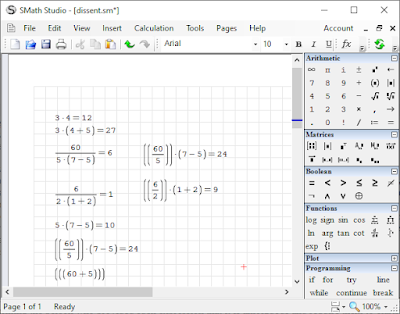
Now SMath is different. It simply won't allow the original expression to be written, it has to be translated by the user, and gets presented in more traditional typeset notation. As soon as type '(' after '5' it inserts a multiplication symbol, which it displays as '.' {actually a vertically centred dot} , whilst otherwise requires '*' to be typed to use multiplication. As soon as type '/' it creates a quotient with numerator and denominator. So 5(7-5) becomes the denominator, 5.(7-5)=10, and the over all result becomes 6. The user has to translate the expression, to clarify their intent. If after typing 60/5, move the cursor and type '(', it simply wraps 60/5 in brackets, thus get (60/5), if type again will get ((60/5)). To move on it is necessary to provide the missing operator, '*' then '('.  Then we can get (60/5)*(7-5)=24.
Experiments using SMath


The gist is that the tools I use would basically require the formula be translated, and I would start by informing the person who provided such expression that it is ambiguous and require them to clarify their intent. For that matter depending on the source of an expression, I wouldn't even rely on BODMAS  being universally understood throughout our community, and would request the supplier to clarify their intent by use of brackets. Once intent has been communicated then I, we can be lazy and remove redundant brackets to calculate the desired value.

Other Environments

As mentioned near the beginning google search and the calculator on android can evaluate the expression: 60÷5(7-5) and return the value 24. An answer which is only acceptable to some. It is also advised that wolfram alpha can also understand the compressed expression and returns 24. This doesn't make the answer correct, it just means the authors of the software have adopted one means of translating the compressed expression. Wolfram appropriately explains its interpretation of various algebraic expressions as it otherwise returns unusual and unexpected results.

It is fundamental to human machine interface design, that the machine augments human ability and assists avoidance of errors. Clearly if software returns a result which is not expected and have to adapt human behaviour to suit the software then the software is an hinderance and impedes human ability rather than assists, and further more the software contributes to the generation of errors.

It is thus likely that wolfram software is little used in some areas for reasons other than its high price, if it does not produce commonly expected results. If to use the software people have to adjust their behaviour to how the software works, then there is a danger that when people are under pressure that they will revert to that which is most natural and produce serious errors.

Expression Parsers

I don't know much about parsing expressions, other than a little bit I read in a book on an introduction to programming in C, and some computer science books using Pascal. Basically behind the scenes the parsers use one or more stacks. A stack of numbers and a stack of operators. So as the string expression is read from left to right, numbers are pushed on the stack and operators on the other, if the stack has enough numbers for the operator, then numbers and operators can be popped from the stack, the calculation performed and the result returned to the stack. Since stacks can be used to parse trees, the mathematical expression can be represented by an expression tree. However it isn't necessary for the parser to transform the string expression to a tree, and then process the tree with a stack if it can process it directly with a stack. In effect the parser transforms the infix expression into an RPN expression and evaluates.

Now infix notation for the arithmetic operations [*/+-] have some level of consistency, the introduction of all the inconsistencies of our actual notation makes the parsing of the expression vastly more complicated. 

The point is someone has to design and implement an expression parser, and some expressions are easier to parse than others, and similarly convert and evaluate a result. But first of all they have to decide on a consistent set of rules. Most programming languages do not allow compressed expressions, all operators have to be explicitly given: this thus requires the user of clarify their intent, whilst otherwise simplifying the rules the parser has to implement.

The real world is messy.


Additional References


Related Posts

Revisions:
[(20/11/2021) 17:41] : Original
[(21/11/2021) 01:27] : Expanded
[(21/11/2021) 18:12] : Expanded/Rewrote + further references

Wednesday, April 01, 2020

Tracking Coronavirus

Apparently the reason we applied restrictions nationwide is because we cannot track the coronavirus: the horse has bolted and we don't know where it is. In that case I'm guessing the numbers behind the W.H.O world dashboard is pure fiction.

As I already mentioned, the purported point of origin of the contagion is China, and the only way it can enter any other country is through discrete points of entry: border crossings, airports and (sea)ports. Entry involves, passports, visa's, tickets, boarding passes, passenger lists.

From all this entry documentation we can identify the suburbs returning residents are returning to, and do so for several months prior to the outbreak. We can identify tourists destinations. Each of these destinations become a point on a map, connected to the points of entry. Along each road network towards these destinations are public facilities. Each facility as a radial reach, for example supermarkets typically at 1 km to 2 km centres so the radial reach is 0.5 km to 1 km. Some larger facilities have radial reach of 5 km, whilst the larger shopping precincts have  a reach of 25 km or more.

But assuming its too late to track passengers, or don't have passenger data to do so, and that we don't know the radial reach of public spaces. Are we completely in the dark? No we're not.

We still have the points of origin: the airports, (sea)ports, and border crossings, and we have the hospitals where the infected are being treated, and we have the suburbs where the infected live. So using a map, pins and highlighters we can mark up a map. Using a geographical information system (GIS) we can build larger models  faster.

We can make assumptions. Say 1 km radial reach, 5 km radial reach and 25 km radial reach. For each of these reaches we define zones, red, orange and yellow. So for any infection point we can plot circular zones around that point, though once we have several points we can generate Delaney triangles and voronoi polygons.

So the points of entry are in the red zone, and the hospitals are placed in the red zone, and so are the suburbs with the infections. The paths between the points of entry and the infected suburbs are in the orange zone until infections identified in the zones. The paths between the infected suburbs and the hospitals are in the red zone.

No one is permitted to exit the red zone. So medical staff and hospital visitors are not permitted to return home, unless there is a contiguous red zone between their home and the hospital. In the red zone people are confined to their home, unless travelling to the hospital. In the orange zone, have the 2 person meeting restriction, in the yellow zone the 10 person limit. Outside the zone's simple social distancing requirements and increased area requirements at gatherings. No one outside the zones is permitted to enter the zone, no one inside the zones is permitted to exit.

As each new infection is identified, the suburb and 1 km radius of its centre is placed in the red zone. Each shop and public place in the suburb is identified and a 1 km radius red zone is placed around such facility.

On the ground the state police, federal police and the defence forces and defence force reserves can block the surrounding roads in and out of the zones. In some locations the road can be blocked with a shipping container.

It should not be necessary to shut down business across the nation of any kind. A pandemic isn't something to worry more about than an epidemic. Once an epidemic is identified in one country, it becomes necessary to lock nation borders to prevent the spread becoming a pandemic. Once located an infection in a country, it is then necessary to lock that area down to prevent the spread becoming a national epidemic. Since it is reaching epidemic status across all countries can only assume that each nation's response has been too late, and their response inappropriate and inadequate. That is  they have failed to contain the contagion to the known points of origin. The known points of origin being the actual identification of infected persons and the suburbs they live in.

Not to put too fine a point on it, but I expect every hospital, clinic, and GP, if not every individual doctor, to map the location of every patient, and to otherwise monitor and track clusters of illness, as it is part of the task of identifying cause.

What we currently have is national panic about something which has only sprung up in a few suburbs. Sure if I plot 50 km diameter circles on the points of infection I will engulf the entire metro area, and if do so with tourist destinations will engulf large regional areas. But it doesn't engulf the entire state. Sure 2/3rd's of population in the metro area, but that leaves 1/3rd of population in rural and mining towns who should be able to get on with business as usual, with some precautionary measures.

If we can home in on the infected suburbs, then we can keep most of industry operational and provide the goods which the quarantined are going to need. Instead we have had wide spread panic, people hoarding, shop shelves emptied and industry shut down. With industry shutdown, the shelves cannot be restocked, because they are not being produced, so doesn't matter if shop can stay open, and people are permitted to go to the shops.

That should not have happened. Employers know where their employees live, they know where the business is located. People in the infected suburbs get time off, and stay home, the rest continue work as usual. Some factories may have people working shoulder to shoulder, but most have workers 10 m or more apart. Offices may have people near enough shoulder to shoulder if work in a cube farm, but many are open plan with plenty of open space. School classrooms they have close proximity seating. Most places however have plenty of space for social distancing. Public transport and getting to work maybe the main problem. Reduced people on public transport and staggered work hours can assist with that.

Most business should have been and should still be operating with only minor changes to their operating procedures. The only businesses which should have some problems are those with personnel actually infected by the virus. But every business has been affected because the government and mass media has effectively declared everyone to be a carrier, when that is not the case.

If we properly tracked  the spread, we could all move on. Noting I already said in previous post, that we cannot get back to normal. Normal is what caused the problem, therefore we have to change behaviour moving forward. But we could move forward faster is we tracked the spread geographically and not just in numbers.

Don't really care about the numbers, want to know where it is. Its not at the end of the street, its not in the town, its something like 150 km away.

-o0o-

So later in the day (1/4/2020) I was informed about TV news report which mentioned differences between New York and Los Angeles, it therefore seemed that someone was looking at things a lot closer than simply country and state level. So I went looking for maps, and found the following:


Whilst the table below the map only lists totals for each state, the map is clearly identifying infections on a more local level. Having had success finding that map, I thought I see if could find map for Australia and more specific South Australia. Found the following:

  1.  Coronavirus in Australia: how many cases are there? Map, latest numbers and statistics
  2. Eastern Australia's coronavirus hotspots revealed: map shows affluent Sydney suburbs hard hit

One other issue is a few days back I held the view that there should be no way that the virus had reached the interior of Australia, so I checked cases for Alice Springs. Was disappointed to find that cases had been reported, and even more disappointing to discover that a large cause was tourists from interstate, in particular Queensland.

  1. Remote community lockdowns take effect as NT coronavirus cases increase to 12
  2. Coronavirus misinformation in Indigenous communities tackled with 'corona cricket' game
  3. Coronavirus strategies in the bush still a work in progress
Clearly the state borders weren't locked fast enough. The maps of the NSW, VIC, QLD, indicate that virus is concentrated in the state capitals. As also expected concentrated in the more affluent areas. The regional infections I'll hazard a guess are due to people in mining and agriculture who have been on overseas business trips.

Where as if I had a map of South Australia (SA), I would be more inclined to reason that should there be any regional infections, then they are a consequence of people from the Adelaide metro area, travelling to the rural regions to raid the supermarkets. Why their local supermarkets aren't stocked is beyond me, other than some unwarranted immediate need for people to stock pile.

At the moment the only regional infection in SA is in the Barossa Valley, the origin of which has been linked to foreign tourists (America and Switzerland). Since there is generally only one road into most of the remote towns, we should generally be able to lock people out off the towns, or otherwise lock people in them.


Related Posts

Revisions:
[01/04/2020] : Original
[02/04/2020] : Found Some Maps

Tuesday, March 31, 2020

Coronavirus Time to Replan and Redesign Our Cities

Everyone is talking about when we  get back to normal. The answer is never. We should not be considering getting back to normal. Normal is what caused the spread of the coronavirus in the first place, we need to change our behaviour and part of that also requires changing the planning and design of our cities.

As I mentioned in the previous post, ancient cities were fortress and walled cities. One thing about a walled city is that it is easier to keep people prisoner in the city than keep the enemy out. From which can surmise, and expand to the concept that it is easier to lock a population in than to lock them out, and thus for border control will always have problem of infiltration. Still in tackling the spread of a contagion like coronavirus, locking a population in, would be beneficial on condition that the population has access to appropriate goods and services with in its own walls. Our towns and cities don't. I've written previously about how bridges wreck the economies of cities, how an optional need for a bridge is transformed into a dependency on the bridge, as business redistributes either side of the bridge. I've argued how we need to directly protect diversity, not protect competition. That economy of scale has benefits, but we also need to avoid concentration of pollutants and dependency on single supplier. We need to known when to boost production to saturate basic need then to scale back and provide more diversity. Henry Ford was right that customer can have any colour they want as long as its black: that is the requirement to supply the basic need in the first instance. Once the basic need satisfied, then can start to get particular.

Any case as mentioned the governments want to increase population density as a consequence of their perspective on urban sprawl. Part of their perspective is that urban sprawl is a consequence of the car, I believe that whilst this is partially so, it is mostly nonsense. Business and architects have been building massive facilities, with reach stretching for kilometres. An office building in the city has people travelling 25 km daily, some even 100 km daily. I read one National Geographic article where a person was spending 4 hours or more each day travelling to some distant location to work. Basically houses affordable one end of country and work available at the other. It equates to poor city and national planning.

Sure part of the problem is workers themselves wanting dormitory suburbs devoid of industry, or at least devoid of the noise and pollution created by industry. But if there is no business of any kind in the suburbs, then the next generation has to travel a significant distance to search for employment: and that generally requires they have a car. How are school leavers going to afford a car? The people of the world aren't the kids in American high school movies, owning cars. Typical families cannot afford to buy cars for their kids, and jobs for kids to work after school hours or on weekends are very few. It is part of the pressure that have to do well in school and get a degree to get a good job.

It would be preferable if we restricted the geographical reach of business facilities, and also the market share of business. As I mentioned in an earlier post, political parties should be restricted to no more than 20% of the seats, so that we can get back to due and proper representation of the people , instead of political parties hijacking our government and contending they have mandates. Afterwards I then extended this to business, restricting them to no more than 20% of the market, where market is defined on multiple levels. So whilst a supermarket may have less than 20% of the national market, when looked at locally it may hold 80% of the market, and so in a local market it may have to adjust.

In the metro areas supermarkets and/or small shopping centres tend to be at 1 km to 2 km centres, and so are in easy walking distance. Though few people walk to them, and that is largely because here in South Australia footpaths are rare. Where there are footpaths there is a chance that the footpath suddenly comes to an end. People thus tend to spend a lot of their time in their cars, wasting fuel and time driving in circles until they can get a carpark as close as possible to a building. To make our cities walkable we first have to make our suburbs walkable. Things are already potentially in walking distance: it's just not convenient to do so.

After my heart attack, I looked on google earth at places I lived when I was a kid, and the places I walked to, to get an idea of how far I could walk, and thus how far I still expect to be able to walk. When looking at places in England, it was apparent, that the construction of motorways, now made it next to impossible to walk the paths I once did. Civil engineers seem more interested in constructing mega-structures, bridges over bridges, than coming up with livable spaces. Here in South Australia, they seem bent on creating the same kind of mess. We may be able to halt that.

The towns and suburbs should be capable of being isolated. No point in referring to the city of Elizabeth or city of Tea Tree Gully (TTG), if all the suburbs making up these cities are otherwise identified as suburbs of Adelaide. Not the least of which is Elizabeth was supposed to be a satellite city: so by definition it should have remained isolated from Adelaide. Gawler is a rural town and it should also remain isolated from Adelaide. That is the grid of urban sprawl, of dormitory suburbs should not spread across the lad between the city centres. There should be clear boundaries between one local government (LG) area and the next.

The network of roads for cars should be more like the network of rails for trains, we should have more intermodal systems, with the ultimate part of the system being on foot and walking. I'm not suggesting get rid of vehicles being able to reach buildings for delivery. However not all buildings need access to large mechanised vehicles. Secondly the majority of items in a building have to be able to pass through a 900 mm wide door way or smaller. So tricycles and smaller mechanised vehicles can be used for transporting most things.

So we can gate of roads for large vehicles, and only allowing access to small personal transporters. The large vehicles have to stop at the gates and be granted access. So for example in Adelaide, we could place carparks around the periphery of the parklands, and only allow human powered vehicles and small electric vehicles into the city. These carparks will also be where the buses also stop unless the buses are electric vehicles. The buses can have electronic passes so they can automatically open access gates.

So in developing the means of limiting vehicle access we are also providing the means of locking the city or suburb up. The road network should provide clearly identifiable corridors between clearly identifiable towns: there should be no grid of roads spread out between the towns.

Increasing the population density of the capital cities is not the requirement. Clearly high population density increases the potential for the spread of a contagion like coronavirus, and it also increases the potential problems when confronted by other attacks by nature: bushfires, earthquakes, hurricanes (tropical cyclones {don't drop the word tropical the entire weather system is dependent on cyclones and anticyclones}).

A capital city is primarily expected to be a cultural, and administrative centre, not a place with a high resident population: but a place which is visited and likely infrequently. Population is preferably concentrated around those hubs which provide needed goods and services with in walking distance of homes.

Schools should be such that all housing within 1 km radius is restricted access and rent only, likewise housing around hospitals. The housing around large industrial facilities or commercial centres should also be rent only and access restricted to those working in the facilities. People are buying housing further and further a drift from their workplaces because they wish to, they are mostly doing so because they have no choice.

Rent only restrictions, moves people in and out of the areas. For example by restricting access to housing in the vicinity of schools, the entire street network around the schools can be made walkable and cars have limited to no access to the area. Children can then walk to school, and otherwise have an environment which includes the school grounds for play outside school hours. The youngest children are placed closest to the school, and the oldest furthest from the school. In this way we don't have to keep building new schools. We only build new schools if we build a new village, town or city. A suburban block, should be built around a hub, either industrial, commercial, cultural, educational, or health focused. These suburban blocks should then be built around an administrative and retail hub.

For example we can define a village as 1 km in diameter, a town as 5 km to 10 km in diameter, and a city as 100 km in diameter. A suburban block likely to be the size of a village (say 1 km x l km square), the central hub can be around 500 m square. In thus block can place around 5000 single storey dwellings.  Each dwelling suitable for one person is suitable for two people and a small child. Thus the population can be extended to 15,000. If add second storey to the houses, then houses suitable for 2 adults and 2 children, so population can expand to 20,000. The highest population densities around the world are around 100, 000 person/sq.km. So with multi-storey buildings the population of the areas can be increased still further. Though I suggest we should put more effort into controlling population growth, not pushing the ideas of economic growth requiring larger populations.

Cities are machines. To function and provide certain goods and services a certain population is needed (the cogs which make the machine function). This does not mean that world population needs to grow, rather it requires the current world population to be in the right place. I've previously mentioned that if the land mass was to be divided into cells 5 km in diameter, then the world population could distribute 1000 people per cell. Those 1000 people need less than a 1 km square for housing. For simplicity assuming a 5 km square grid, it would put a 4 km ring between each village. That ring could be a nature reserve or agricultural land. Now I'm not suggesting we distribute the world population in such manner. Not the least of which is we can house a lot more people in each 5 km cell than 1000 people.

What I am suggesting though is that a lot of facilities can be placed in a 500 m x 500 m hub, that activity can be made more local, and that localities can be isolated, yet connected. That the connections can be blocked, can be severed.

As I mentioned in the previous post, the corinavirus should not have spread further than 1 km radius of the discrete entry points to each nation. When the epidemic was reported in China, then each nation should have responded to prevent a pandemic. When pandemic was declared then each nation needs respond to prevent a epidemic in their nation. Just because their is a pandemic does not mean there is a epidemic in your nation. For certain the horse had already bolted when the gate was closed. However as I said, we still have passenger lists to track returned locals, and the suburbs they returned to. Plus we have rough idea of tourist destinations. So using a geographical information system (GIS) we could track the local government (LG) areas which these returning individuals likely visited. We can lock down these LG areas.

But assuming its got out off hand and its spread into the cities. We know its spread into the cities because the hospitals are dealing with cases. The hospitals have a radial reach. Their patients are arriving from known suburbs. Those suburbs have shopping centres and other public places. Each of these public places has a roughly known radial reach. So once again using a GIS we can map out the region most likely affected. Without any other information, we can assume various radial reaches for each facility. So we can mark a 1 km zone, a 5 km zone, and a 25 km zone. Each zone we give a hazard level, the closest to the point of origin has the highest hazard level, the most distant the lowest hazard level. As we identify people in the 1 km zone, we change from a point of origin to a path, and define the radial zones about this path. The path notionally defines a direction of travel, and the localities where resources need to be committed.

At the moment we have a response which says its an epidemic: but its not all over the country, there is a good chance it will be if we handle it as if it already is spread far and wide. We did not need to shut down the national economy, to shutdown all public gatherings and all public businesses. They needed shutting down where the contagion was and is. We don't know where that is! Really! For certain there are people out there who maybe spreading the contagion without knowing it, but there also millions of people out there not spreading anything. But clearly its being spread where people are known to be infected. Is that your neighbourhood, chances are the answer is no. Does this mean you can ignore safeguards? No it doesn't! When restrictions are lifted does this mean you can go back to normal? No it doesn't! Normal got you into this situation in the first place, normal needs to change.

Places are too crowded, and they are crowded because business is permitted to construct facilities to cater for large uncontrolled crowds of people from distant locations. For example there is no real need for people to shop in Adelaide, and there shouldn't be permitted to encourage people to chop in Adelaide. Forget about the never ending arguing about shopping hours every year, the reach of Rundle mall business should be restrained. People don't need to travel into the city, they should shop locally. If they shop locally it will reduce traffic congestion into the city, it will strengthen local community, and also reduce the potential spread of any future contagion beyond the city hub. Local shopping precincts need to be restored and enhanced, and should be within walking distance. Planning regulations should permit doing so.

Planning regulations also need to be modified to better encourage home business. Currently most of South Australia's development plans restrict home business to an area of 30 sq.m. Which is an area of 5 m x 6m, which is approximately 2 x 6m shipping containers side by side. Which seems like plenty of space, but I suggest it may be preferable to define limitations based on area of land: which takes into consideration required parking areas for residents, employees and customers. Whilst parking areas shouldn't be based on area used by business but on predicted traffic levels. For most home business probably looking at no more than 1 customer vehicle per hour: maximum. For many probably in the range of 1 vehicle per month: with most activity occurring by post, fax, phone, email, or web site.

There have already been complaints that local bricks and mortar business are loosing business to online business. The lock down for the cornavirus will result in increased use of online sales, which will likely increase demand for couriers. Noting that local business can use couriers to supply faster than Australia post. When the lock down is over, will there really be need to fill the offices and retail stores? If people can work from home, why not have them work from home all the time, and only meet up in person occasionally? That way only need to rent large office space for a meeting possibly once a month.

Taking note that don't have to pay people by the hour, because really business is not buying time. Traditionally people got paid wages, if work was intermittent such as daily or weekly. People got paid salaries because, what they needed to do, and when it needed to be done was uncertain, so they got paid by the year. How many hours the workers work is largely irrelevant, what the workers accomplish is more relevant. If a worker completes their workload in half the time working from home, you don't pay them half the pay. Completing the work faster should be worth more, so the workers should get paid more for the work completed. Or otherwise spend less time working and get the same pay. Also if people working from home are more productive, then they can be fed more work. Though they are unlikely to want to maintain the same pace and effort throughout the year: so may experience a short term spike in productivity followed by a return to more sustainable production levels.

Any case an increased use of the internet and online sales and online business, will see a reduced need for commercial/industrial building space, and an increase in residential renovations to create home business and work space. This will reduce traffic congestion, at the traditional peak times of the day. However there should be an upsurge in the need for couriers and small delivery vans taking goods to houses, and between houses. This should use far less fuel than all the commuters travelling back and forth to distant work places. Even though people may place orders at different times and different days, the suppliers can still optimise their delivery times and days and travel routes, so that delivering to the same street as few times ass possible. (We used to have bread and milk delivered to the door stop. so its not that difficult).

Most of our modern world is highly wasteful and inefficient. Cars and mobile phones mostly promote poor planning, incompetence and inefficiency. The supply of simple goods and services does not require human interaction, if you have to use a telephone to get information and complete a transaction then the suppliers supply systems are inefficient. If have to meet face to face, or in person, then highly inefficient. Human interaction maybe sociable, but its not efficient. How important is sociable to the supply, versus efficiency of supply? If efficiency of supplier is more important and should have higher priority, then should aim to eliminate people from the transaction process.


... to be continued ...


Related Posts

Revisions:
[31/03/2020] : Original

Thursday, March 26, 2020

Coronavirus: Unnecessary Panic and Shutdown

Whilst coronavirus (COVID-19) can result in death, most people recover. More importantly the point of origin of the virus is purported to be China. The only way it can get to a neighbourhood near you is via a discrete point of entry to your country. That is it has to cross the border or coastline and whilst these are continuous the legal entry to a country is at discrete points, these being border crossings, airports and (sea)ports. At these controlled entry points, entry involves, passports, visa's, tickets and passenger lists. If everything is working well I don't expect anything to get beyond 1 km radius of such entry point. I expect it is possible to quarantine and shut everything down within 1 km radius of such entry point, and that systems exist and are already in place to be able to do so: part of the forward planning and management of borders.

Now occasionally something may get through the border controls, due to it either being not detectable or otherwise not being checked for in the first instance. In which case time passes and the gate is closed after the event. From the control documents for persons entering, we should know the point of destination for locals returning. We don't need to know who they are, all we need to know is the suburb they are returning to. From the suburb we get the local government authority district (LGAD) or council area, that the suburb is located. We only need shut down the local council area, not the nation, and not the state.

Further more from the point of entry, we know the path to get to the suburbs where the returning locals reside. Each public facility along that path also has a certain reach. For example supermarkets are typically at 1 km too 2 km centres: so they have a rough reach of 0.5 km to 1 km. Some larger facilities have a reach of 5 km, and the large shopping malls, plaza's and precincts have reach of 25 km or so. The state capital cities have reach across the state, but not every day of the week.

So using a geographical information system (GIS) it should be possible to map out, a zone where the infection is likely to spread, and lock that region down. That is lock down local council areas, not the entire city, not the entire state and not the entire nation. To shutdown the entire nation, the national economy and cause national panic is irresponsible.

With  a local council area locked down, people within that council area can go about business as usual. Deliveries of goods and services can be made into the area, but not from the area, unless it supplies something not available from elsewhere. People living in the area, but working outside the area are confined to the area, and therefore cannot go to work, unless the job does not pose an issue. More over the local council areas in the infected zone which is locked down, will be neighbouring, so as long as can travel to work place with in the locked down zones, can travel between council areas.

It is inconsiderate of people in the Adelaide metropolitan area to be traveling 100 km's or more into the remote rural towns and emptying the supermarket shelves. To start with the metro supermarkets must have incompetent management if they cannot keep the shelves full. The rural towns typically have low demand, and are typically unable to supply all the needs of the local population on a regular basis. It is somewhat akin to living on an island, with the ship coming in once a year, and stock up when the ship arrives. So city dwellers coming up and emptying our shelves is not appreciated. 

Secondly, the point of origin of the infection, for the state is the metropolitan area. Some 2/3rd's of  the Australian population is in the state capitals, and around 1/3rd of the population in the remote regions. The remote regions thus have the potential to keep on with business as usual and avoid infection, if infection is locked down in the metro areas. So the city dwellers shouldn't be spreading the infection into the rural towns.

It is also to be noted that one theory is that 60% of the population needs to be infected for herd immunity to kick in. The 2/3rd's population in the cities is near enough the 60%, so locking the cities down and restricting traffic to the remote and rural regions seems like a reasonable imposition.

It is lunacy that people 150 km or more from the nearest infected region have to comply with national restrictions, and social distancing. It is an unnecessary imposition and inconvenience, and excessive impact on the economy. The government should act to shut the panic down, not shut the economy or nation down.

If we lock a suburb down, then the first issue will notice, is that most suburbs are worthless dormitory regions with no local services. If shut a local council area down, then will notice that there is also a lack of local services. So the question is why is there a lack of services? What kind of development and planning approval is taking place that large regions are devoid of local services.

Take the Yorke Peninsula for example, this is split into two major council areas: the Copper Coast (CC) council district (area: 773 sq.km, pop:14,139), and Yorke Peninsula (YP) council district (area: 5834 sq.km, pop:11,056). The largest commercial town in the area would be Kadina in the CC area, with a population of 4,857. So people in the YP area have to travel out of the area into the CC area for major shopping. Towns in the region are some 25 km apart with less than 1000 people, typically around 100 to 200 people. People expect to travel 25 km to 100 km to get their shopping done, as local stores don't have the local population to sustain stores with large variety of goods.

Whilst in the metro area there are supermarkets approximately every 1 km, servicing populations measured in 1000's. Major wholesale warehouses are in the metro area, most factories are in the metro areas, and the airports and seaports where imported goods arrive are part of the metro area. So why are metro supermarkets running out of goods?

Sure there maybe a 24 hour to 48 hour delay if panic buying empties the shelves? But that should not generate an incentive for people in the metropolitan area to travel over 100 km to do grocery shopping when usually only travel 1 km to 5 km. Why panic buying in any case, and what's the great demand for toilet paper?

Shouldn't be any panic buying. Admittedly once upon a time my parents got paid monthly, so got used to monthly shopping. Have pantry and fridge and freezer. Generally have a months supply of groceries in any case. Even so, there are still some things which have to buy weekly or fortnightly, very little if anything which need to buy daily. The fridge and freezer and cupboards have limited space. But there are only a few things which are perishable and do not last long even if kept in a refrigerator. Most of such perishable things you do not necessarily need. You wouldn't take perishable food stuffs on an expedition. You would take long life food stuffs: canned food, powdered and dried food stuffs. Food stuffs which do not require a fridge or freezer.

No need to buy in bulk, nor a need to spend extra money if you can't afford to. Just change what you usually buy, buy fewer perishables and get some extra canned foods. Also no need to buy in bulk, just get an extra can or pack during each ordinary shopping day, and build up reserves slowly. That way industry can also slowly build up production, and both manufacturing, wholesale and retailers can keep stock in supply. Noting that some businesses are shutting down, as a consequence of unnecessary panic. Sure if know going into quarantine, may need to buy extra. Then again there are all those people who get in a panic when have long weekends, a mere extra day, so the prospect of a fortnight or month in quarantine, definitely not going to cope.

As for the northern hemisphere, what's all this rubbish about isolation and keeping kids occupied? What do you normally do every single year during the winter months? As I recollect being a kid in England, walked to school in the wind, rain and snow: but during the school break trapped in doors. So travelling in bad weather accepted, but playing out in it, less acceptable. Point is being trapped in the house for days, weeks, or a few months is part of every year life: so shouldn't be an issue. Secondly hasn't everyone been complaining for years that kids spend too much time in doors, first complaints about reading, then watching TV, and these days playing video games or using social networking websites? So doubly, shouldn't be an issue.

As for social distancing I would contend that people get too close to one another in public spaces in the first place, and that shaking hands is a relatively dumb trait (mainly because I don't overly appreciate getting my hand crushed by halfwits who have read some junk pop psychology. Fools who will find out the hard way how wrong the psychology is.)

-o0o-

So consider that our towns are poorly designed, as a consequence of becoming reliant on privately owned mechanised transport. There are calls to increase population density. The architects seem to have taken this as a need for more grandiose multi-storey buildings: which I contend is a mistake. As I have mentioned before urban sprawl is not created by the car, but by architects and their multi-storey buildings and other large facilities. These facilities draw a workforce from distant locations and supply to distant locations. That is these buildings have an unacceptable radial reach. It is a planning issue, to restrict the size of buildings in an area, and also to restrict their reach and catchment areas (hinterlands).

As far as I know part of the incentive for building codes stemmed from two major events: the great fire of London (1666) and the great plague of London (1665 to 1666), along with cholera out break of 1854. In both cases the primary problem was a lack of isolation and circulation between buildings. In the one case the problem was access to and around buildings to fight fires, in the other there was a lack of ventilation and air circulation. On the other hand the circulation and movement of people otherwise contributed to the spread of disease. Though any significant building code didn't eventuate until the  London Building Act 1844 : in other words slow to respond. (Not quite:Rebuilding  of London Act 1666, and Rebuilding of London Act 1670 ).

Any case our historical fortress cities, and rural villages could for the most part be isolated and locked down, whilst modern sprawling suburbs are more difficult to lock down, and remote rural villages are a few hours drive away, not several days walk.

I've mentioned before that whilst South Australia has many council regions, some of which are referred to has cities, the suburbs of these regions are all listed as suburbs of Adelaide. Our development act shouldn't just place limits on separation distances between buildings, it should also separate and keep separated the cities, the towns and the villages. There wasn't any point in building the satellite City of Elizabeth and then allow urban sprawl to join it to the Adelaide metropolitan area, nor for the rural town of Gawler to become increasingly connected into the metropolitan area. In all this urban sprawl market gardens have disappeared under housing. Agriculture seems to keep moving north, closer and closer to the Goyder's Line. It doesn't seem sensible.

If we kept nature strips between villages, towns and cities, and minimised the number of connector roads between. Then they can be isolated more readily than sprawling suburban grids. More importantly each community has more localised facilities and is not dependent on modern technology. The car isn't entirely necessary. Trains can shift cargo, as can small trucks and vans.

People are considered able to walk at about 5 km/hr and cycling considered to be about 4 times faster, so around 20 km/h. People already spend around 1 hour stuck in cars to travel less than 20 km. Whilst my contention is that an industrial city state should be 100 km diameter, a town 5 km to 10 km diameter, a village 1 km diameter, and estates 100 m diameter. All of which get isolated by nature strips. Assuming can travel for 5 hours each day, then can walk 25 km/day, or cycle 100 km/day. Travelling from the perimeter to the hub of a 5 km diameter town would thus be a 30 minute walk, and at the hub most of the needs can be bought. I find it strange that as a kid we used to walk 2 km to 4 km to do the weekly shopping using a shopping trolley, no car needed: whilst monthly shopping was a car trip to a distant supermarket to buy bulk items.

If we restricted the reach of buildings, as far as it is practical to do so, then local communities would be stronger, and more resilient, and service quality would improve. Not the least of which the customer you upset lives at the end of your street, or at least in your local neighbourhood, not out of town.

If we strengthen local business and protect diversity rather than competition, unemployment should reduce, and energy usage should also drop.

It should also be noted that the response to a pandemic and epidemic is no different for a nation. About the only difference it makes is if the nation is dependent on imports for its survival, in which case it may have difficulty getting what it needs.

Now what we have with urban sprawl is increased potential for contact and transmission of contaminants of all kinds. With isolated communities, say villages within towns, and towns within cities, then have increased potential to isolated, and otherwise continue business as usual.

The layout of our cities is a mater of defence and security. The current response to a pandemic/epidemic has demonstrated a lack of security: bio-weapons can easily bring the worlds nations to their knees. The response is some what pathetic given that the majority of people infected with COVID-19 have recovered and will recover.

As it is, here in SA we could put a barrier across Port Wakefield road, and prevent those from the Adelaide metropolitan area travelling to the North West of the state. For that matter it is a major failing that infection has already spread to the Barossa Valley approximately 75.4 km from Adelaide, no way should it have been permitted for the virus to transmit more than 25 km from the centre of Adelaide. Whilst there are some long back ways to some places, for the most part there is one and only one way to get to most of the remote towns.

Locals returning from overseas, we should have been able to track their destinations. Tourists, shouldn't have been able to leave the proximity of airports and (sea)ports. For certain we have the problem of those people who left and dispersed before we knew we needed to track. But tourists mostly visit tourist destinations. So once again we have a few places we can lock down and isolate.

There is no need to shut businesses down or pubic events. As I said we are some 150 km away from where the infected are. The doctors, dentists have gone into isolation. The local gym has shutdown.

I understand why I just had an appointment with cardiologist over the telephone, instead of the appointment I originally had for face to face in Kadina. Normally the cardiologist travels from Adelaide all the way to Kadina, and I likewise have to travel around 50 km to up the Yorke Peninsula to Kadina. Adelaide is where the infections are, so we don't want people from Adelaide potentially spreading the infection to the north. But since we haven't got infections, I don't see why local dentists, gym and other facilities need close.

Not the least of which the gym is used by rehab patients, recovering from various conditions: heart attack, COPD, cancer, etc... Apparently my heart ejection fraction hasn't improved after 12 months at the gym, but neither has it deteriorated. The doctor wants to put me on more medication, and now I've got to find some other way to get exercise (I'm a problem as I don't fit the text book solution: no high blood pressure, never smoked, don't drink, and as for being over weight everyone says BMI meaningless. Primarily thin as are most people in the rehab group, more a concern if we lost weight.). Going to the gym, was only reason not to be at home, and not to be working at computer. It is unnecessary to be closing specific types of business across the entire nation.  Yet I am meant to go to the chemist and get the new medication (prescription being posted out), and then with in a or week go to local doctors to get blood tests.

Sure we don't know where the virus maybe, but we do know where it is, and where it can spread from. So unless it arrives in a neighbourhood near you, there is nothing to panic about, and even if it does arrive, and you get the thing, you are more likely to recover than die.

As mentioned above rural towns are small, typically with one road through, if you blink whilst travelling then you might not notice the towns. These towns can be shut off, but there is no need to, because the infection has not reached that far, and it shouldn't because the metro area in the vicinity of the airport should be shut off.

So there maybe people out there who do not yet know they have the virus, but once they do know, we shut off their neighbourhood. That could be a suburban block or a single street. From any individual we can identify friends and relatives they may have been in contact with, and so have additional neighbourhoods to monitor and/or shutdown. It maybe slow but it doesn't throw the population into turmoil and wreak havoc on the economy. We simply identify, trap and isolate the contamination and stop it spreading from a source. If there ain't no source, it ain't gonna spread.

Therefore there should be no need to shutdown where there is no existing source of infection.

{I was interrupted 3 times and lost my track. The basic gist, is that the way our towns and cities are designed impacts on our capacity to isolate locally. The building blocks are too big, we should have smaller villages, within towns, and towns within cities.}


Additional Reading: (the stuff you ought to read)

  1. WHO COVID-19 dashboard
  2. Coronavirus disease (COVID-2019) situation reports
  3. Coronavirus (COVID-19) current situation and case numbers
  4. Government response to the COVID-19 outbreak | Australian Government Department of Health
  5. The maths and ethics of minimising COVID-19 deaths | Pursuit by The University of Melbourne
  6. Imperial-College-COVID19-NPI-modelling-16-03-2020.pdf
  7. What is herd immunity?
  8. Will warming spring temperatures slow the coronavirus outbreak?
  9. View from The Hill: Entertainment venues closed in draconian measures to fight the virus
Architecture, Population Density, Housing and Climate
  1. Density by stealth: A house for Gen Y
  2. Housing Diversity: Adapting 1.0 Infrastructure for 3.0 Lives
  3. What Would Boyd Do? A Small Homes Service for Today
  4. Infrastructure priorities in the face of bushfires, floods and droughts
  5. Ethical and scientifically sound architectural solutions to the climate crisis
  6. Public spaces bind cities together. What happens when coronavirus forces us apart?
  7. Outbreaks like coronavirus start in and spread from the edges of cities

Related Posts

Revisions:
[26/03/2020] : Original